QR Codes in Video Marketing: The Bridge From Screen to Phone
How a 1990s factory barcode became the standard way to act on what you see on a screen, and what that means for live video.
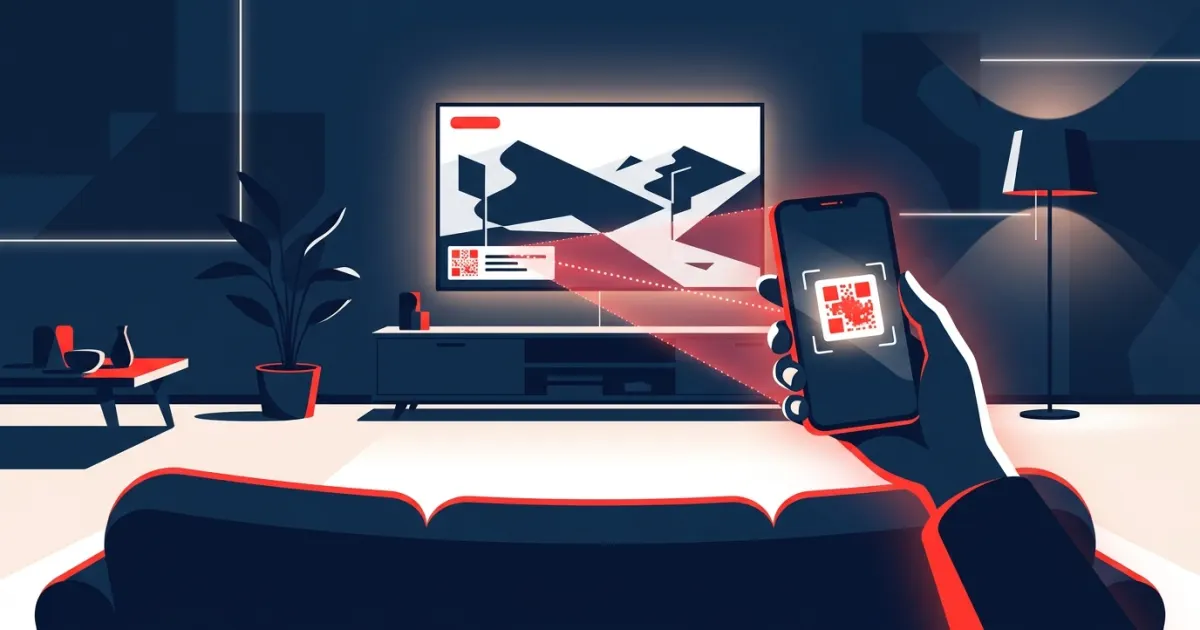
QR codes became the standard bridge from screen to phone for two reasons: most people now carry a phone whose built-in camera can read them, and scanning beats typing a URL from across the room. For live video, a QR code on the stream can turn someone watching on a TV or monitor into a visitor on your site in a few seconds. And with a tracking link behind it, every scan can be counted.
Key takeaways
- QR codes date to 1994 and were first adopted by the auto industry for production tracking. Their developer, DENSO WAVE, chose not to exercise its patent rights, so anyone could use them freely.
- Two shifts made them mainstream: phone cameras that scan without a separate app, and smartphones in nearly every pocket. Pew puts US adult smartphone ownership at 91% in 2025.
- Usage keeps rising but varies by region. GWI data shows about half of internet users scanning monthly, with the US and UK near the bottom of the ranking.
- Television showed that QR codes can work as an ad format, from NBCUniversal's shoppable ads to Coinbase's 2022 Super Bowl spot.
- On live streams, what matters most is size and contrast, time on screen, a readable backup link, a trustworthy destination and tracking.
A factory barcode that went mainstream
The QR code was released in 1994 by DENSO WAVE, then a division of DENSO Corporation. The "QR" stands for quick response. According to DENSO WAVE's history of the code, it was adopted by the auto industry "for use in their electronic Kanban," a production-management system that tracked work from production to shipping. The company kept its patent rights but "declared that it would not exercise them," and in 2000 the code was approved as an ISO international standard.
QR codes also have error correction built in, which helps them stay readable when part of the code is obscured or degraded. DENSO WAVE describes four error correction levels that restore data when part of a code is dirty or damaged. Raising the level makes the code more robust but also larger, and "typically, Level M (15%) is most frequently selected" (DENSO WAVE). That trade-off matters on video, where compression can blur fine detail.
What turned QR codes into a screen-to-phone habit
The camera learned to read them
On many phones, scanning no longer needs a separate app. Apple's support page tells iPhone users to "open the Camera app from the Home Screen, Lock Screen, or Control Center," then "hold your device so that the QR code appears, then tap the link to open the content" (Apple Support). Google's help page describes the same flow on supported Android devices: point the camera at the code and tap the banner that appears (Google Help).
Nearly everyone has a scanner in their pocket
According to Pew Research Center's mobile fact sheet, about nine in ten US adults (91%) own a smartphone, based on a survey conducted from February to June 2025. That's up from 35% in Pew's first smartphone survey in 2011.
Contactless habits during the pandemic
COVID-era distancing put codes on restaurant tables. In a July 2020 NPR report, a patron described how at one Harlem bar "you can use your camera and the code that's on your table to look at the menu without ever interfacing with a piece of paper" (NPR). Menus, check-ins and payments made the gesture familiar to many people.
Usage is up, but unevenly
DataReportal's October 2024 Global Statshot, citing GWI survey data, found that the share of internet users who had scanned a QR code in the past month rose from 44.3% in Q2 2022 to 50.5% in Q2 2024 (DataReportal). The same report notes that countries in Asia and Latin America see the highest use, while the USA and the UK sit "near the bottom of the current ranking." It also found that people aged 35 to 54 were more likely to interact with QR codes than those aged 18 to 34. For marketers in the US and UK, that's a reminder not to treat scanning as universal: make the code easy, and give people a fallback.
How TV turned QR codes into an ad format
Watching video with a phone in hand is a long-standing habit. In a 2018 custom survey of its Media Enthusiast Community, Nielsen found that 45% of respondents watched TV while using digital devices "very often" or "always." In the same survey, 71% had looked up information related to the TV content they were watching, and 35% of TV viewers had shopped for products and services advertised on the main platform (Nielsen). The QR code gave that habit a direct path.
Broadcasters noticed. In 2019, NBCUniversal rolled out shoppable ads in which viewers point their smartphones at "scannable QR codes that pop up to indicate when a product is available for sale" (Marketing Dive).
One of the most talked-about tests came at the 2022 Super Bowl. Coinbase ran a 60-second ad that was little more than a colorful QR code bouncing around the screen. CNN Business reported that Coinbase's chief product officer said on Twitter that the landing page got more than 20 million hits in one minute, with engagement six times higher than previous benchmarks. The app crashed for about an hour (CNN Business via KRDO). The company also had to "throttle traffic for a few minutes" (MediaPost). Two lessons came out of it: people will scan a screen when curious, and the page behind the code has to be ready.
What it means for live video
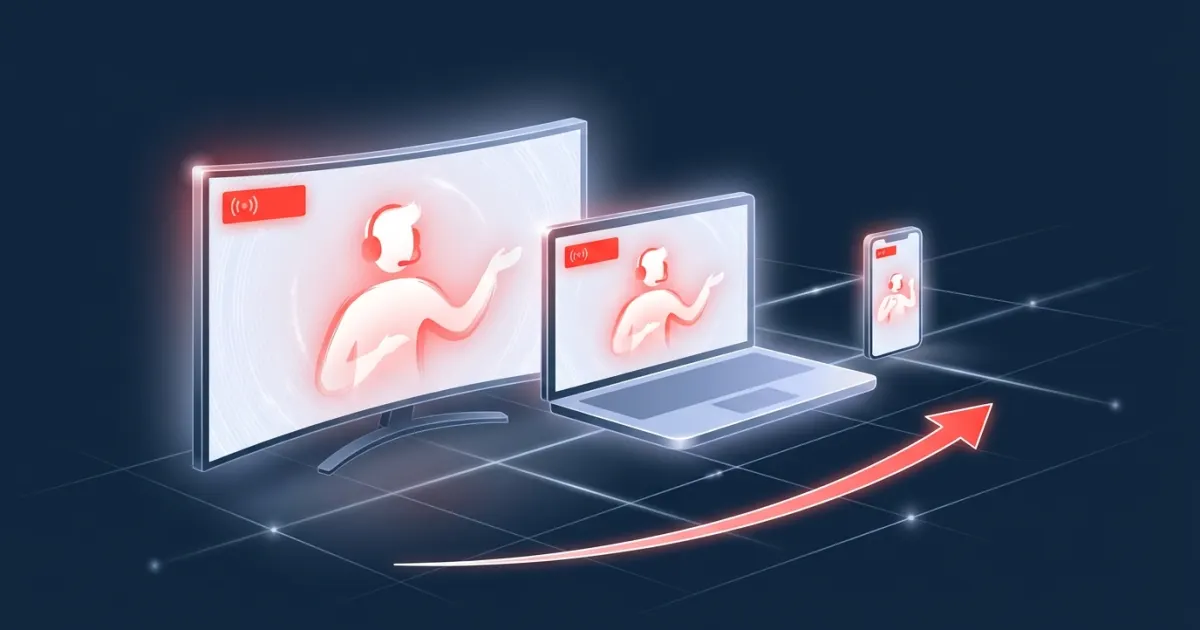
More live and on-demand video now plays on the biggest screen in the house. Nielsen's July 2026 Gauge found that YouTube alone captured a record 14.2% of US TV viewing (Nielsen). On a TV, a link in a description is hard to use, but a code on screen can be scanned. On a desktop, viewers may be busy with a game or a keyboard while their phone sits nearby. A stream QR code works best when it respects both situations.
| Way to move a viewer to your site | How the viewer acts | Strength | Weakness |
|---|---|---|---|
| QR code on screen | Points their phone camera | Fast, works from a TV or monitor, countable | Hard to scan if they're watching on the same phone |
| Short link on screen | Types it in | Works on any device | Typing is friction, and typos happen |
| Spoken URL | Remembers and types it | Feels personal | Easy to forget, hard to measure |
| Promo code | Enters it at checkout | Measurable at the sale | Only captures people who buy |
Practical rules for QR codes on live streams:
- Make it big and high-contrast. Live video is compressed, and small codes blur. Use strong contrast (a dark code on a light background) and leave a clear margin around it. Our guide to QR codes on live streams covers sizing and testing.
- Keep it on screen long enough. Viewers drop in mid-stream. A code that flashes by for a few seconds is easy to miss, while a code that stays up for minutes gives late arrivals a chance.
- Pair it with a readable short link. Mobile viewers can't point their camera at their own screen.
- Make the destination trustworthy. The FTC warns that scammers hide harmful links in QR codes, and advises: "Many QR readers preview the link they will send you to. Make sure there are no spelling mistakes or switched letters in the link before you click" (FTC, September 2026). It also tells people to inspect the URL of any code found in an unexpected place (FTC, December 2023). Use a domain viewers can recognize, and say where the code leads.
- Plan for replays. A code in a VOD or clip keeps working after the live show. Re-uploads can also be edited: after the Coinbase ad, a security expert warned that someone could repost the commercial with a malicious QR code swapped in (SiliconANGLE). Point codes at pages you control, and keep them live or redirect them sensibly.
- Track every placement. Give each stream or channel its own link, add UTM tags, and compare scans with what happened on your site. See how to track live stream ad results.
How AD on Live uses QR codes
QR codes are built into AD on Live's stream overlay. When no ad is running, the overlay shows a QR code that opens the streamer's booking page, along with the price per minute ("AD Here — $X/min"), so viewers and brands watching can book the next slot. Streamers can hide this idle state.
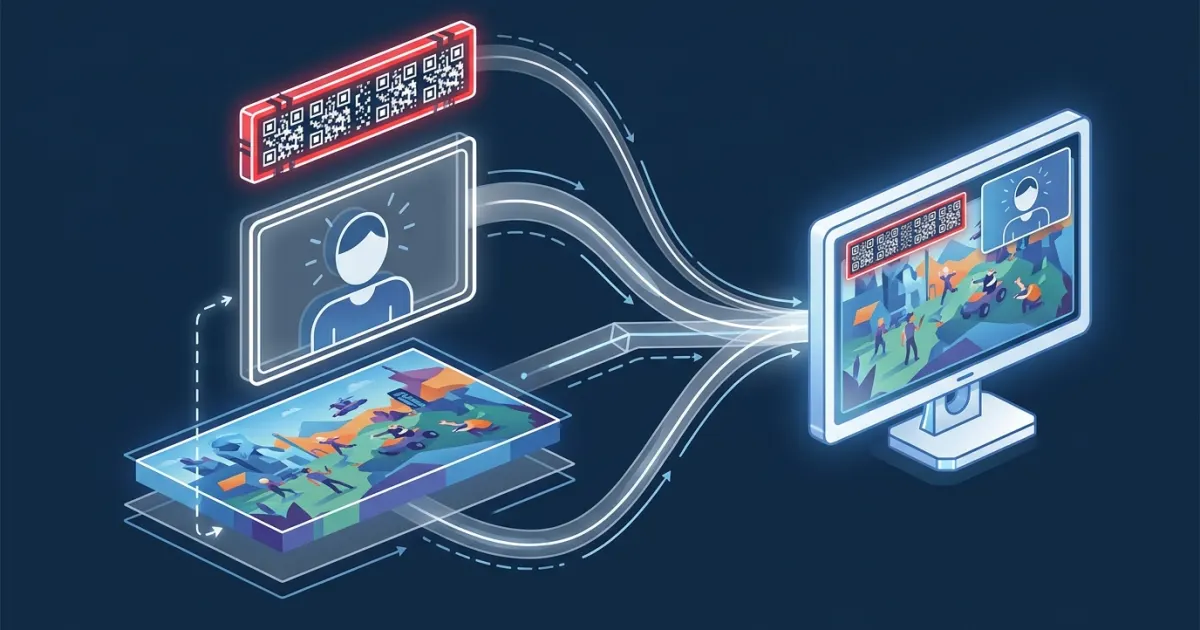
While an ad runs, the overlay shows the advertiser's banner together with a QR code, a countdown and a small "Ad" label. The code goes through a short tracking link (adonlive.com/r/{code}) that counts scans and clicks, then redirects to the advertiser's URL, or to the streamer's booking page if no URL was given. The link keeps redirecting and counting after the ad ends, so the code still works in VODs and clips. Advertisers get a completion email with the click count. AD on Live counts scans and clicks per campaign. It doesn't measure impressions or viewer numbers, so pair it with your own analytics for the full picture. For banner layout tips, including where the QR area sits, see designing a banner ad for a live stream. For the bigger picture, see what stream overlay ads are.
The bottom line
QR codes won because they ask almost nothing of the viewer: no app, no typing, just a camera they already own. Live video adds the reasons that make it work: phones in hand, TVs that can't be clicked, and audiences who want to act while the moment is live. If you have a product that's easy to try from a phone, see how to book a QR-enabled banner on a live stream. Streamers can learn how the overlay works on the streamers page.
Frequently asked questions
Why are QR codes used in video ads?
They let a viewer act on an ad with the phone they already hold: point the camera, tap the link, and land on the page. That works even when the video plays on a screen the viewer can't easily click, such as a TV.
Do people actually scan QR codes?
According to GWI data published by DataReportal in October 2024, 50.5% of internet users said they had scanned a QR code in the past month in Q2 2024, up from 44.3% in Q2 2022. Use is highest in Asia and Latin America and lower in the US and UK.
Do I need an app to scan a QR code?
Often not. Apple's support page explains scanning with the iPhone Camera app, and Google's help page explains scanning with Google's built-in camera app on supported Android devices.
Are QR codes safe to scan?
A QR code is just a link, but scammers can hide harmful links in them. The FTC advises checking the link preview for misspellings or switched letters before opening it, and being wary of codes in unexpected places.
Why should a QR code on a stream also show a short link?
Viewers watching on their phone can't easily scan their own screen. A short, readable link next to the code gives them a second way to reach the same page.
Sources
- qrcode.com/en/history/
- qrcode.com/en/about/error_correction.html
- support.apple.com/en-us/102680
- support.google.com/camerafromgoogle/answer/12033278?hl=en
- pewresearch.org/internet/fact-sheet/mobile/
- npr.org/transcripts/886624261
- datareportal.com/reports/digital-2024-october-global-statshot
- nielsen.com/insights/2018/juggling-act-audiences-have-more-media-at-their-disposal-and-are...
- marketingdive.com/news/nbcuniversal-rolls-out-shoppable-ad-unit/566011/
- krdo.com/money/cnn-business-consumer/2022/02/14/coinbases-strange-qr-code-super-bowl-ad-br...
- mediapost.com/publications/article/371166/coinbases-super-bowl-qr-code-ad-crashes-the-app....
- nielsen.com/news-center/2026/tv-usage-kicks-usual-summer-slowdown-fueled-by-world-cup-and-...
- consumer.ftc.gov/consumer-alerts/2026/09/see-qr-code-parked-somewhere-dont-scan-ityet
- consumer.ftc.gov/consumer-alerts/2023/12/scammers-hide-harmful-links-qr-codes-steal-your-i...
- siliconangle.com/2022/02/14/coinbase-super-bowl-qr-code-ad-crashes-website-raises-security...
Advertise on a live stream
Book a sponsor slot by the minute. You're charged only if the streamer approves your ad.
See how it works